
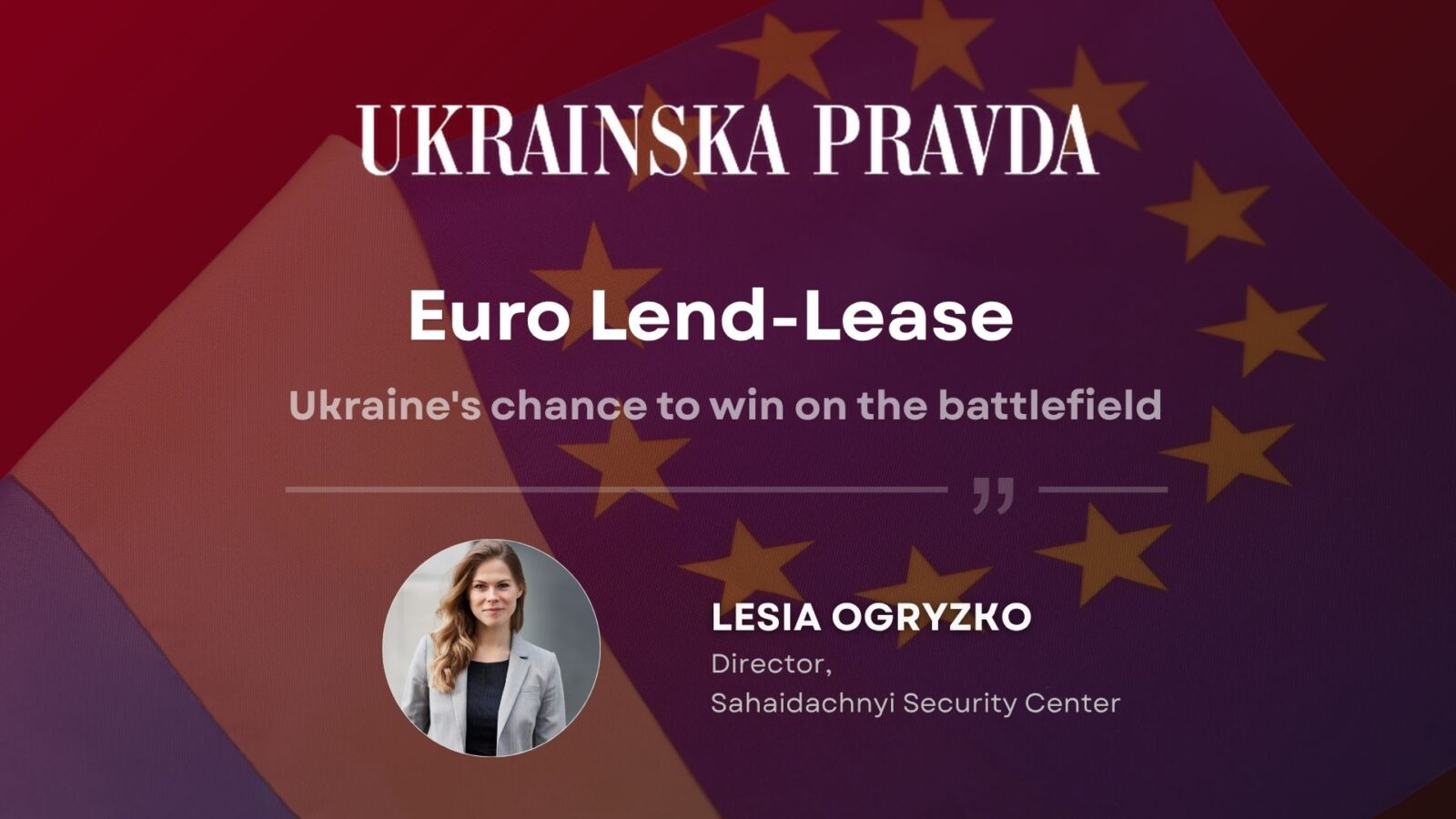
For the second time in the war, the battlefield is showing signs of a systemic rather than merely tactical shift of initiative, away from Russia and toward Ukraine’s Defence Forces. In a new column for Ukrainska Pravda, Sahaidachnyi Security Center Co-founder and Director Lesia Ogryzko argues that this advantage — limited and still unstable — opens a window of opportunity that depends above all on Europe.
This window carries the risk of public complacency, but with timely, focused action, it offers a chance to end the war from a position of strength, on terms favourable to Ukraine.
Ukraine has been close to this before in autumn 2022, after the Kharkiv and Lyman operations and the liberation of right-bank Kherson. That chance was not just lost but blocked by international partners, particularly the United States, which effectively obliged Kyiv to postpone the counteroffensive to summer 2023 — giving Russia the time to regroup, mobilise and fortify.
By early summer 2026, Lesia Ogryzko writes, Ukraine has regained a comparable window. Ukraine’s Defence Forces have effectively halted Russian advances on key axes and mounted deep “midstrike” operations, degrading Russian rear logistics.
What is at stake now is not the classic victory or the territorial gains of 2022, but the chance to end the war from strength and reduce the likelihood of renewed Russian aggression over the next five to ten years.
The article stresses that this opportunity is temporary. Citing Brigadier General Andrii Biletsky, Ogryzko notes that the window runs only six to nine months, with the next six “the most important.”
Yet the picture is no better than in 2022, and in some ways harder. Ukraine has largely solved the dependence that hurt it in 2022 — the Defence Forces now run on 82% domestically produced weapons and equipment as of January 2026. However, the bottleneck has shifted from supply to people; the exhaustion of units under constant pressure is now the central problem.
The only real game-changer for Ukraine, Ogryzko argues, is collective Europe. It can keep up minimal support that holds the line without breaking the war open, or show strategic agency and play a truly decisive role — “this time with a plus sign.” The current €90 billion over two years is substantial, but it is not an agency.
Lesia Ogryzko emphasizes that what Ukraine needs is a next-generation European Lend-Lease (based on the 1941 American Lend-Lease Act) with three features:
- scale matched to a continental war of attrition
- a single delivery mechanism
- credit-and-investment logic rather than grants alone.
In most cases European support is held back less by a shortage of political will or resources than by an inability to decide quickly, share responsibility, coordinate bureaucracies and overcome internal vetoes. Euro Lend-Lease therefore needs a single executive hub — at the level of the European Commission or a “coalition of the willing” — with a mandate for procurement, contracting and logistics on an accelerated decision cycle, outside the unanimity rule.
Lesia Ogryzko sets out lines of support — financial, technological, industrial, medical, political, and informational — spanning the defence industry, personnel, critical components, training, treatment of the wounded, and the fight against Russian disinformation.
Given how deeply the strains have accumulated across Ukrainian society and the army over more than four years, Ogryzko judges this window is very likely the last. Continued attrition without a breakthrough in 2026 would push the war into slow strategic erosion, with unpredictable results.
Lesia Ogryzko notes:
“This is why it is critical for Europe not to lose this chance and not to repeat the miscalculation of 2022, when the chance to end the war with Russia’s defeat was senselessly squandered.”
The question, she concludes, is whether Europe is ready to move quickly enough to turn a short window into a lasting strategic advantage for European security as a whole.
For more insights and arguments, read the full column on Ukrainska Pravda (in Ukrainian).