
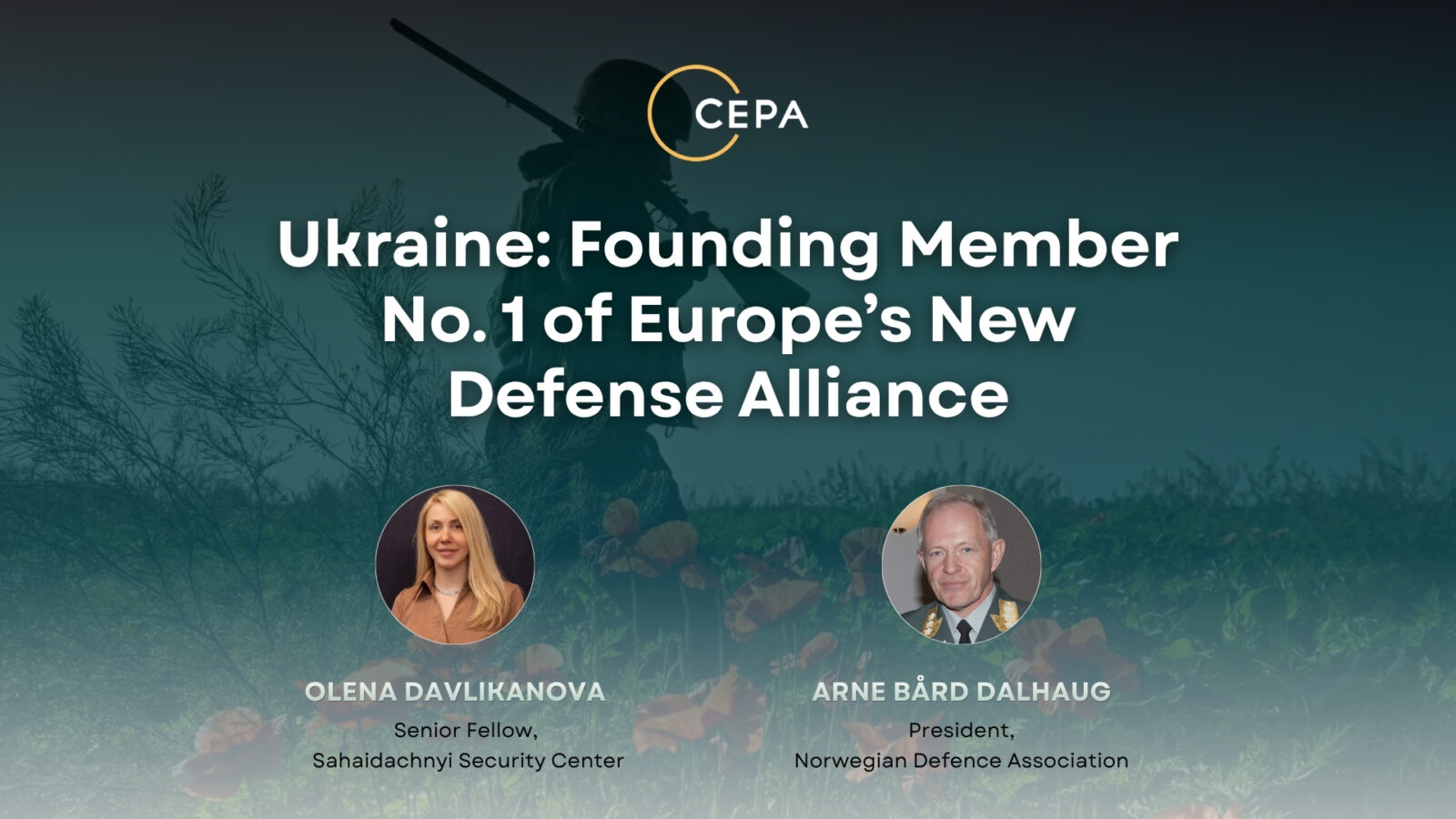
Europe is simultaneously confronting two strategic realities: the erosion of certainty around long-term U.S. security guarantees and the largest interstate war on the continent in eight decades.
In a new article for the Center for European Policy Analysis (CEPA), Olena Davlikanova, Senior Fellow at the Sahaidachnyi Security Center, and Lieutenant General (Ret.) Arne Bård Dalhaug — President of the Norwegian Defence Association and Senior Adviser to the Norwegian Atlantic Committee — argue that Europe cannot build a serious defence system against Russia without Ukraine inside it from the start.
For years the working assumption was that Russia could carry the war to Ukraine while its own territory stayed untouched. That no longer holds: Ukraine’s long-range strike campaign against targets in Moscow, St Petersburg and beyond has rattled the Russian leadership and keeps chipping away at the Kremlin’s so-called red lines.
As those lines lose their force, European governments gain the political room to harden their approach to Russia instead of managing around Moscow’s threats. Talk of a new security system is gaining momentum, driven by the prospect of a diminishing US presence. The proposals run from a multi-tier NATO to a larger role for the EU’s mutual-defence clause under Article 42.7 of the EU Treaty to alternative alliances or CoWs.
The most detailed thinking comes from a May report chaired by former Finnish President Sauli Niinistö, More Europe in defence – three pathways, which sets out three routes:
- Europeanisation of NATO — gradually building up European pillar of the Alliance;
- “New European multilateralism” — strengthening cooperation through smaller formats, including a coalition of willing states with its own decision-making and military structures, able to act even if NATO is blocked;
- Deeper, EU-led defence integration — using the bloc’s financial, industrial and regulatory tools to build capability faster.
Going further, European Commissioner for Defence and Space Andrius Kubilius has advanced the vision of a European Defence Union.
Davlikanova and Dalhaug see Europe’s real difficulty not in a shortage of ideas but in the number of vulnerabilities it has to close at the same time. It has to:
- hedge against long-term uncertainty over US security commitments;
- reduce its dependence on a long list of American enablers, from nuclear deterrence and satellite reconnaissance to strategic airlift, ballistic missile defence and electronic warfare;
- rebuild military capabilities left to atrophy for decades, at a cost the Kiel Institute puts at roughly €500bn over a decade.
Behind all of it sits a premise Europe has been slow to accept: Russia will remain a threat whatever happens next. If Putin leaves the scene, another leader in Moscow may inherit the same ambitions, and even a defeated Russia would keep its imperial appetite. A ceasefire could ease the pressure without removing what causes it, and might dull Europe’s sense of urgency in the process.
Ukraine speaks directly to this set of problems. It is the only European country with recent experience of large-scale new generation war against the Russian military, it fields one of the largest armed forces on the continent, its defence-industrial base is evolving faster than any peacetime military can match, and it holds operational knowledge no exercise can reproduce.
In practice, integrating Ukraine means:
- keeping its military well-financed and wired into European defence planning;
- expanding initiatives such as the Drone Deal and joint defence-industrial projects;
- developing common European–Ukrainian air and missile defence;
- embedding Ukrainian officers, planners and innovators inside European institutions, where they can shape force development directly.
An arrangement of this kind would also let Europe move on Ukrainian defence integration ahead of either EU enlargement or NATO accession.
For more insights into what it would actually take to put Ukraine at the heart of European defence, read the full article on CEPA’s Europe’s Edge and two summaries in Norwegian:
- Norwegian Defence Association – Norges Forsvarsforening;
- Nettavisen Nyheter.