
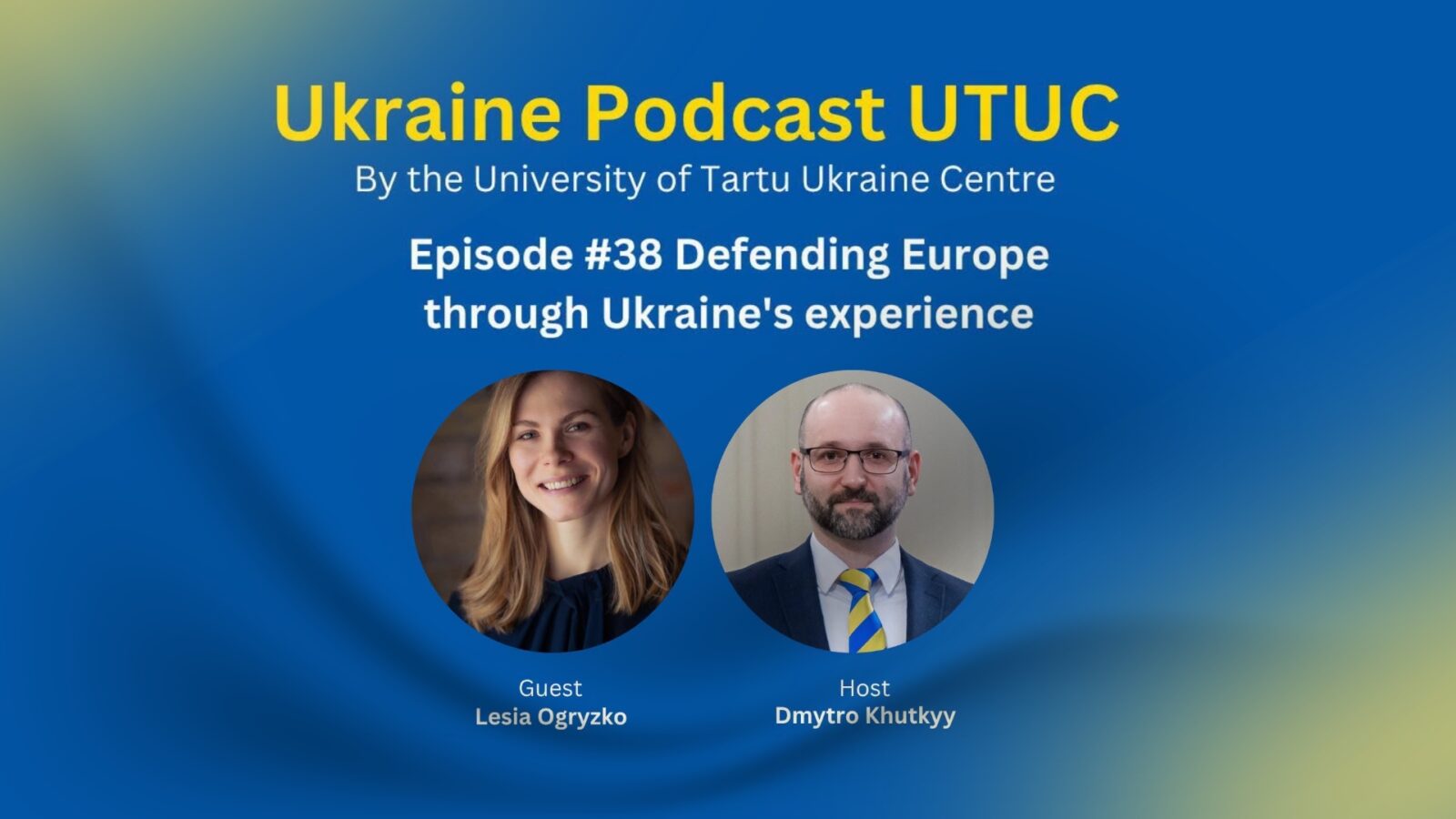
Many of Ukraine’s partners still describe Russia’s war as a matter that concerns Ukraine alone. In a conversation with Dmytro Khutkyy for the University of Tartu Ukraine podcast, Sahaidachnyi Security Center Director Lesia Ogryzko explains why that reading is mistaken, and what Europe can learn from how Ukraine has fought over the past decade.
The refrain she keeps hearing from European partners is that Russia is at war with Ukraine, not with Europe or NATO. For Lesia Ogryzko, this is a serious misconception. Seen only through a kinetic lens, the war looks confined to the Ukrainian battlefield; seen against the drones, severed undersea cables and cyber operations Russia runs across the continent, it is a war already waged against much of Europe.
Anyone who studies Russia through the Gerasimov doctrine, she notes, comes to understand that “the kinetic aspect of warfare is sort of the last resort” — the final stage of a much longer sequence that begins with years of preparing a population to accept it.
Asked what leaders should do when the signs of war are invisible, she sets out a twofold approach:
- The first part is an honest conversation with societies about the threat and an acknowledgement about probable hybrid and sub-threshold measures from Russia against other European states. This would require European societies to hold a contingency plan.
- The second part is restraint. The point is preparation and honesty rather than “waging hysteria and scaring your societies to death.”
Lesia Ogryzko places particular weight on the Nordic and Baltic states, whose threat perception is closest to Ukraine’s and who need little convincing of the danger. She sees the region as the natural ground for a future defence alliance with Ukraine as one of its cornerstones.
Ukraine’s battlefield experience has already proved its relevance far beyond Europe, including in the Gulf states. In return, Ukraine needs to be treated as a full member of such a community, on terms of reciprocity.
From more than a decade of war she draws three lessons for Europe:
- Mass still matters — the old bet on a handful of expensive platforms has given way to a need for ammunition, drones, interceptors and trained personnel at scale.
- Agility matters too, from the speed of adaptation at the front to the decentralised procurement.
- Societal resilience, the Ukrainian model of total defence, where a war that reaches energy, water, agriculture and local governance makes the whole-of-society response a central pillar of a country’s defence rather than a supplement to it.
Asked what partners should do to help Ukraine win, Lesia Ogryzko returns to the question of imagination. Europe and the United States are still caught inside a Russian narrative of invincibility, and the first move is to break out of it.
“Now what I would like all Europeans and Americans to do is imagine for a moment that Ukraine can win and then take this image and start believing it.”
Alongside, it requires a genuine Russia strategy, without which Western policy settles into keeping Ukraine from losing rather than backing it to victory, and a readiness to help Ukraine on the offensive in the kinetic and cognitive domains alike.
Listen to the full episode of the University of Tartu Ukraine podcast, Defending Europe through Ukraine’s experience