
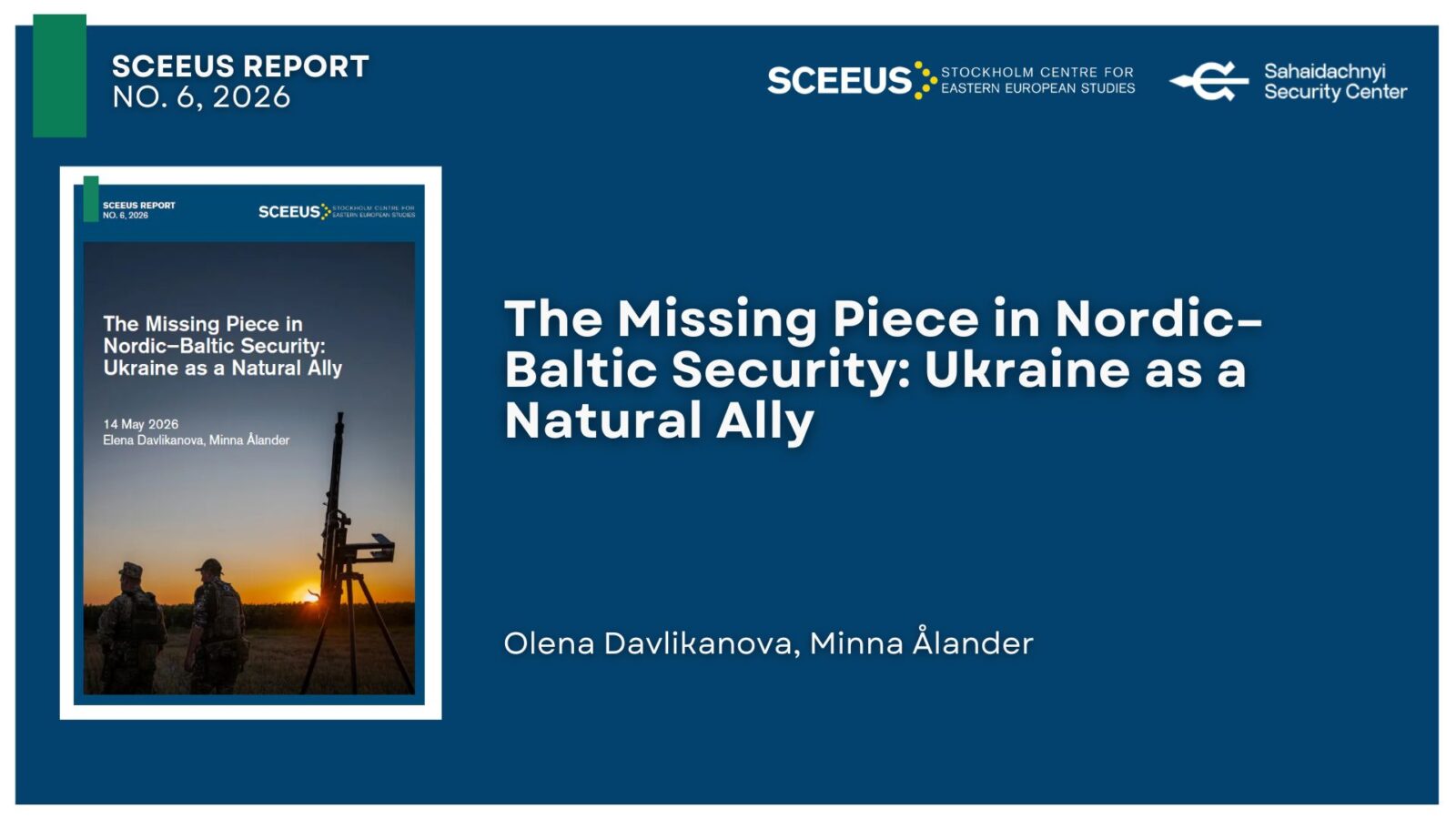
The Stockholm Centre for Eastern European Studies (SCEEUS) has published a new report — The Missing Piece in Nordic–Baltic Security: Ukraine as a Natural Ally — co-authored by Sahaidachnyi Security Center Associate Senior Fellow Olena Davlikanova and SCEEUS Analyst Minna Ålander.
It makes the case that Ukraine should be treated not as a recipient of aid on Europe’s periphery, but as a natural extension of the continent’s north-eastern flank and a security provider in its own right.
The authors argue that Ukraine’s battlefield experience, combat innovation and growing defence-industrial base should be far more deeply integrated with the Nordic and Baltic countries (NB8) through co-production, bilateral security agreements and wider cooperation formats.
What makes the alignment so natural? Davlikanova and Ålander point to a shared starting position. All are small or medium-sized democracies, several with their own memory of Russian aggression, and the threat is now contiguous — a battleline running from the Black Sea to the North Sea, with Belarus and China backing Russia. Ukraine’s resistance, they note, has already delayed, disrupted and degraded Russian capabilities that would otherwise threaten the Baltic Sea region and the High North directly.
The report also explains why the NB8 cannot treat the Russian danger as distant: they are already facing sub-threshold warfare that could escalate into an undeclared war.
The research works through the geography of this threat in detail:
- Russia’s recalibrated “Greater Baltic” theatre concept;
- Kaliningrad’s shift from offensive asset to vulnerability (now that Finland and Sweden are in NATO);
- Belarus as an extension of Russia’s Western Military District;
- the High North, where the Arctic’s strategic centrality and Russia’s reliance on the GIUK gap expose the Nordic countries.
Ukraine can be a source of capability the NB8 urgently needs. The shift to low-cost, scalable strike systems seen in Ukraine is precisely what small and medium-sized states with limited resources require.
Battlefield data is another asset Ukraine brings: a 2026 Ukrainian framework now lets partners train AI models on real combat datasets without the data leaving Ukrainian custody — a win-win for both sides.
The authors lay out a set of recommendations spanning:
- military officer exchanges and red-teaming on Ukraine’s uncrewed systems and Delta battlefield system;
- deeper intelligence cooperation;
- a joint response strategy to sub-threshold warfare;
- shared centres of excellence;
- full JEF membership for Ukraine;
- in the longer term, a European Defence Council outside EU and NATO structures to coordinate defence among like-minded countries.
Supporting Ukraine should not an act of generosity but a calculation of the NB8’s own security: a defeated Ukraine would leave them facing a larger, battle-hardened Russian army reinforced by the people of the territories it had seized.
Ukraine already sits inside Europe’s line of defence, and any security arrangement for the years ahead will have to be built around it.
For more details and insights, read the full report on the SCEEUS website.
Download file