
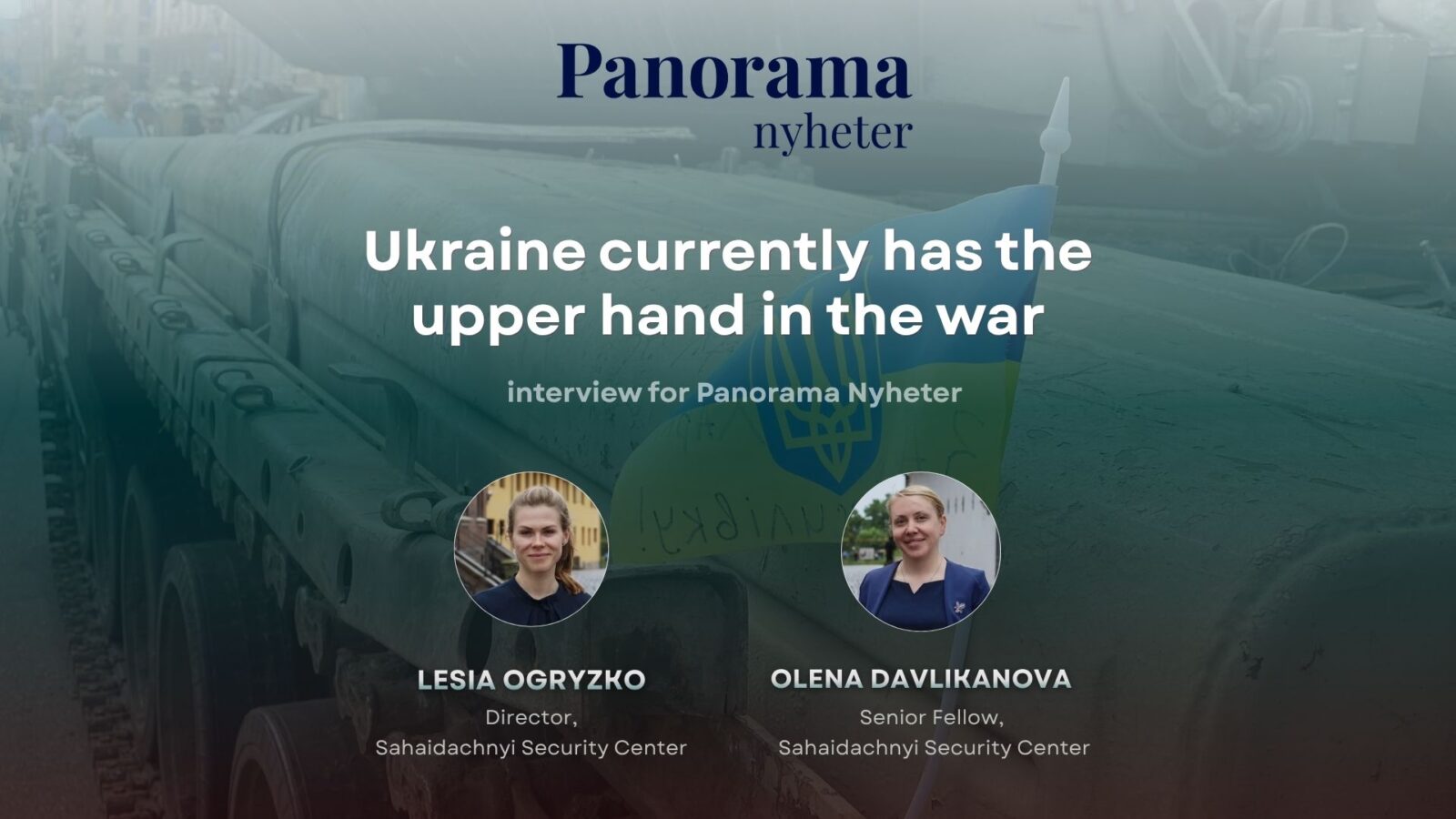
For the first time in three years, Ukraine is gaining the upper hand in key areas of the war with Russia. In an interview with Gunnar Zachrisen for the Norwegian outlet Panorama, Sahaidachnyi Security Center Director Lesia Ogryzko and Associate Senior Fellow Olena Davlikanova explain what has changed on the battlefield and why Ukraine’s partners should act on it now. The two analysts spoke during a delegation visit to Oslo and the Norwegian Defence University this week.
They observed that May 2026 was the first month since 2023 in which Ukraine recaptured more territory than it lost at the front — a shift reflected both in statements by the Commander-in-Chief of the Armed Forces of Ukraine, Oleksandr Syrskyi, and in reporting by the Ukrainian monitoring group DeepState.
For Lesia Ogryzko, Ukraine regaining the initiative is one of the most significant developments of the past few years. She points to several reasons:
- expanded drone production that has slowed Russian advances and clawed back ground in the east and south;
- strikes wearing down Russia’s oil and military industry;
- a war arithmetic now turning against Moscow, with monthly losses outpacing mobilisation.
All of this, Lesia Ogryzko says, means that for the first time in years Ukraine has the chance to keep building its advantage. She draws a contrast with 2023, when the situation was almost reversed: Ukraine then had no shortage of soldiers willing to fight but lacked equipment and depended almost entirely on Western military support.
Olena Davlikanova points to one area where support could go further: Ukraine’s drone factories.
“For 2026, Ukraine plans to produce seven million drones, but the capacity is twenty million. It’s only a matter of obtaining enough external financing,” she says.
Among the innovations in military logistics the two analysts highlight is DOT-Chain, a marketplace through which a brigade commander can order the equipment a unit needs directly, instead of routing every request through the defence command.
“It’s like being on Amazon, only for military equipment,” Lesia Ogryzko explains.
Read the full interview with Panorama (in Norwegian)