
After more than four years of full-scale war, Ukraine faces a sobering reality: previous strategic concepts have reached their limits. Many of existing concepts (e.g. “steel porcupine” or “functional defeat”) increasingly appear as an illusion, as they are prohibitively costly and difficult to replicate across domains.
While debates continue about ceasefires and the limits of concessions, the Sahaidachnyi Security Center posed a different question: what strategy can eliminate the threat from Russia entirely?
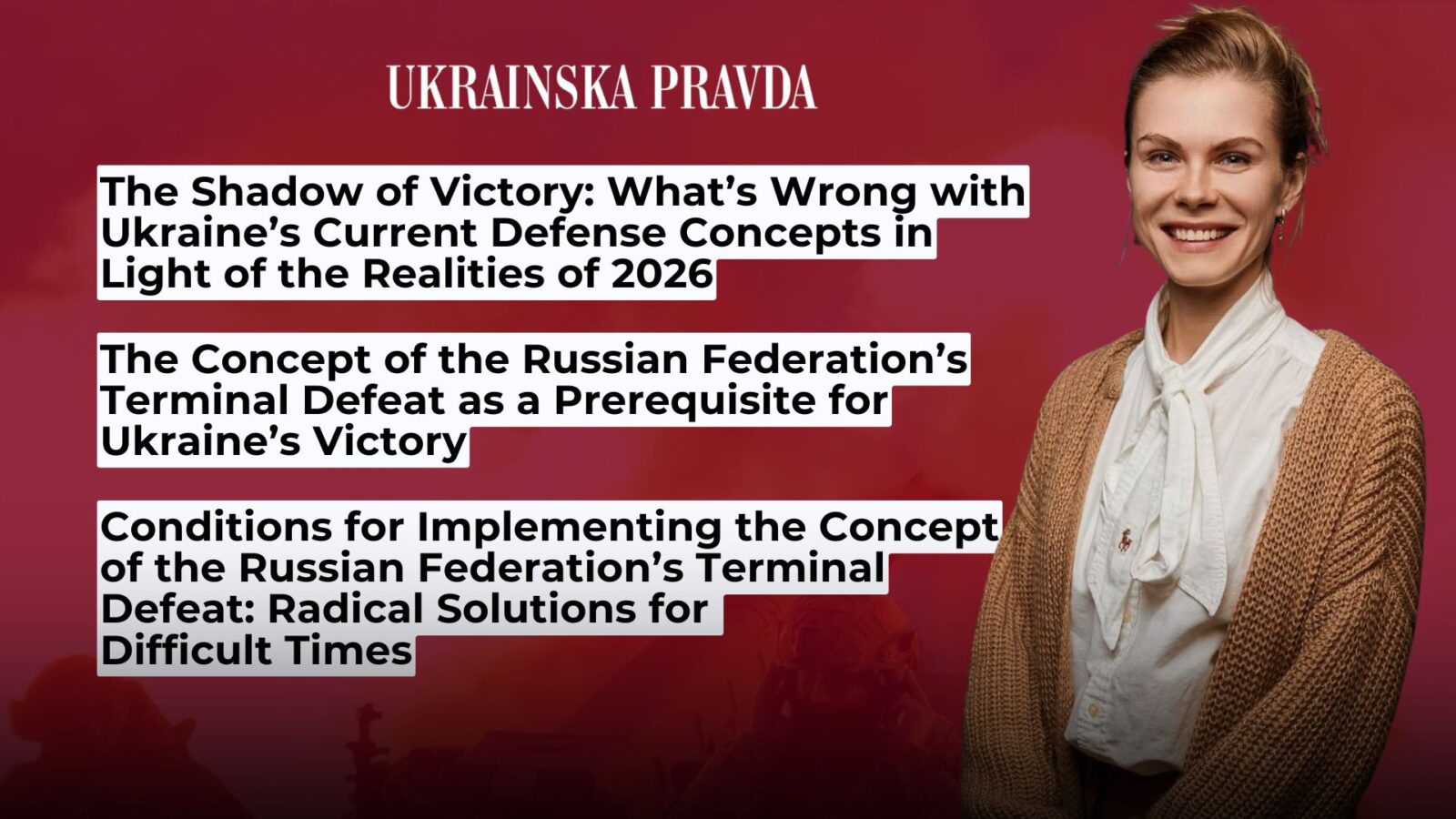
This forms the foundation of the terminal defeat concept as a condition for Ukraine’s victory — a strategic framework detailed in three analytical articles by Lesia Ogryzko, Director of the Sahaidachnyi Security Center, published in Ukrainska Pravda.
The first article in the series — The Shadow of Victory: What’s Wrong with Ukraine’s Current Defense Concepts in Light of the Realities of 2026 — examines why Russia is waging two simultaneous, independent wars (on the front lines and deep inside Ukrainian territory) and why addressing only one cannot lead to victory.
It introduces the terminal defeat framework through two complementary vectors:
- liquidation, which targets critical bottlenecks to trigger irreversible degradation in Russia’s system, and
- deterrence, reimagined not as an end goal but as an instrument to buy time for the liquidation strategy to take effect.
The second article — The Concept of the Russian Federation’s Terminal Defeat as a Prerequisite for Ukraine’s Victory — operationalizes the two-vector framework by detailing how each should function in practice.
It also reframes deterrence as a strategy for preserving the defensive perimeter while buying time — not through indefinite positional defense, but through accelerated technological transformation and the creation of lethal zones that systematically exceed the adversary’s mobilization capacity.
The third article in the Ukrainska Pravda series — Conditions for Implementing the Concept of the Russian Federation’s Terminal Defeat: Radical Solutions for Difficult Times — tackles the implementation challenge. It examines how to execute a victory strategy when resources are depleting and the gap between ambitions and capabilities keeps widening.
It identifies seven “centers of gravity” — from national morale and military leadership to artificial intelligence integration and defense-industrial capacity — where concentrated effort on limited resources can generate nonlinear gains in effectiveness.
The core value of this series lies in connecting maximalist strategic goals — complete structural destruction of Russia’s military capability and its aggressive regime — with realistic assessment of Ukraine’s resource constraints.
It maps a route from Ukraine’s current reality to strategic victory by identifying where concentrated resources create outsized effects and where buying time actually advances the goal.