
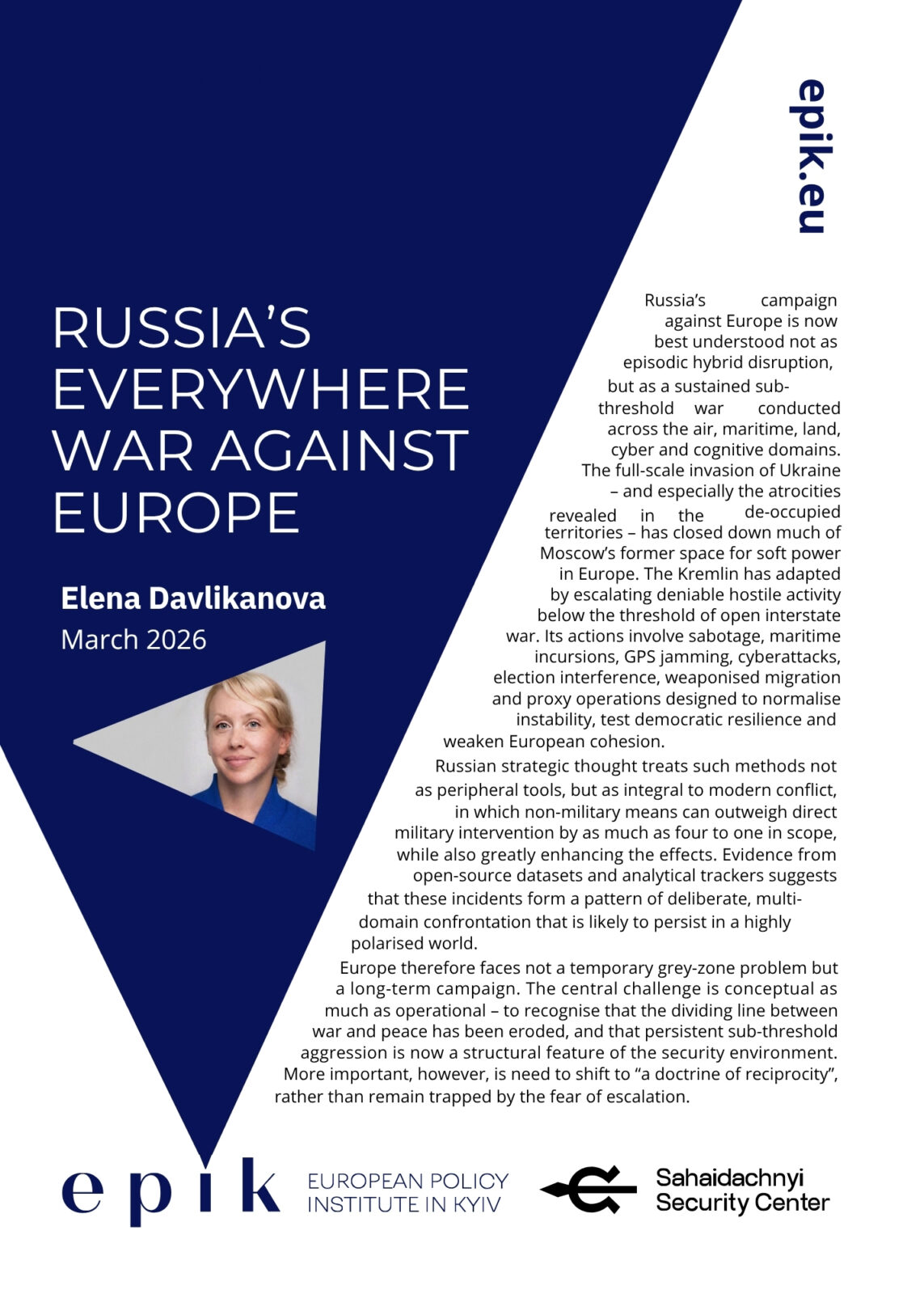
Europe is already at war – but not in the form we are accustomed to. Russia is conducting a sustained sub-threshold campaign across the air, maritime, land, cyber and cognitive domains. The analytical brief argues that, since 2022, the Kremlin has shifted from instruments of soft power to a scalable model of deniable aggression.
This form of aggression is implemented simultaneously across military, informational, economic and technological dimensions. These activities form a persistent pattern of multi-domain confrontation with no indication of temporariness.
The brief highlights the evolution of Russian strategic thought: non-military means are not auxiliary but can outweigh conventional military force, while conflict unfolds without formal declaration. At the same time, a critical asymmetry emerges – democratic states operate within legal and political constraints, whereas Russia deliberately exploits these constraints while remaining below the threshold that would trigger a collective response.
The core conclusion is that the distinction between war and peace has been eroded, and sub-threshold aggression has become a structural feature of the security environment. This requires a shift in approach – from reactive deterrence to a doctrine of reciprocity, where hostile actions are met with proportionate responses. In this context, Ukraine is identified as a critical component of Europe’s security architecture, possessing unique operational experience in countering contemporary multi-domain warfare.
The analytical brief was prepared with the support of and published on the website of the Institute of European Policy in Kyiv (EPIK).
Author: Elena Davlikanova