
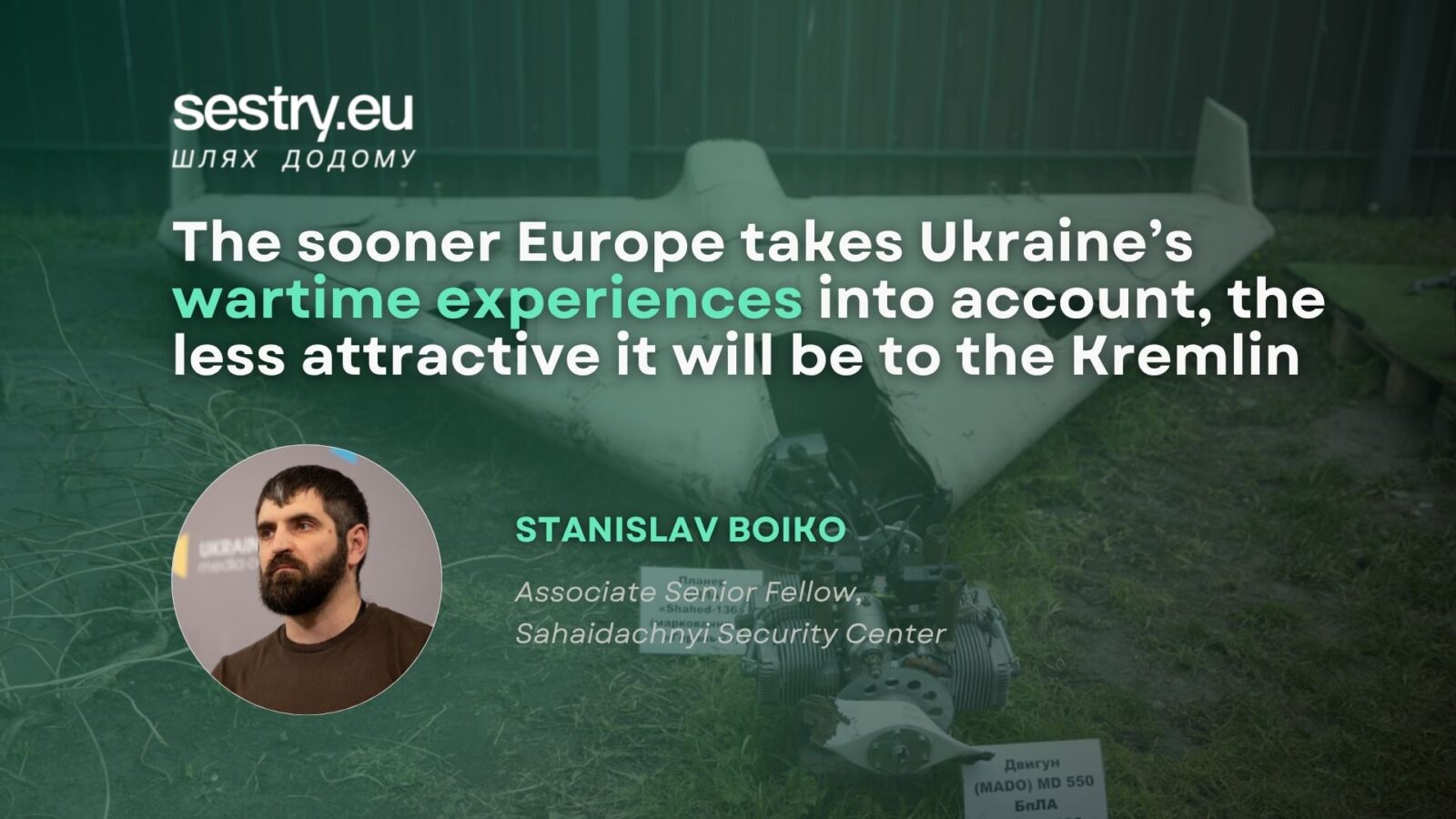
Stanislav Boiko, Associate Senior Analyst at the Sahaidachnyi Security Center, provided extensive commentary to Sestry on Russia’s prolonged, covert, and systematic preparation for conflict with Europe.
The piece by journalist Iryna Skosar also features our Сenter’s new analytical report — “The Denied War: The Russian Grey-Zone Aggression against Europe and Its Unfolding Trajectory” — which examines the trajectory of Russian grey-zone aggression.
In the article, Stanislav Boiko draws attention to a critical shift in the nature of Russian actions in late 2023 — the transition from hybrid operations to actions bearing the hallmarks of state terrorism and direct preparation for the armed phase of conflict. Among the first manifestations, he identified attacks on critical dual-use infrastructure in the Baltic and Scandinavian regions.
According to his research, further escalation is evident in the use of unmanned systems and aviation incidents, particularly in the context of drone raids over Polish territory and the incursion of MiG-31 interceptors into Estonian airspace.
Explaining the dual purpose of this activity, Stanislav Boiko noted: “On one hand, it creates constant psychological pressure and tests the response speed of NATO air defense systems. On the other hand, it serves a far more important function: operational preparation of the environment for a potential large-scale conflict. In this context, modern drones function not merely as tools of influence but as instruments for precise mapping of Europe’s strategic infrastructure.“
According to his observations, the war in the Middle East creates additional opportunities for Russia through dispersed Western attention, economic instability, and delayed recovery of Western military resources.
Stanislav Boiko emphasizes that Europe’s greatest vulnerability right now is not the potential Russian strike itself but insufficient readiness for warfare involving mass deployment of unmanned systems and other technologies. Therefore, the speed of integrating Ukrainian battlefield experience into the European defense system will directly affect the Kremlin’s calculations. The better prepared Europe proves to be for this type of conflict, the less attractive the idea of open aggression will become for Moscow. Effective preventive preparation can stop war before it begins.
We invite you to read the full article on the Sestry website via the link.