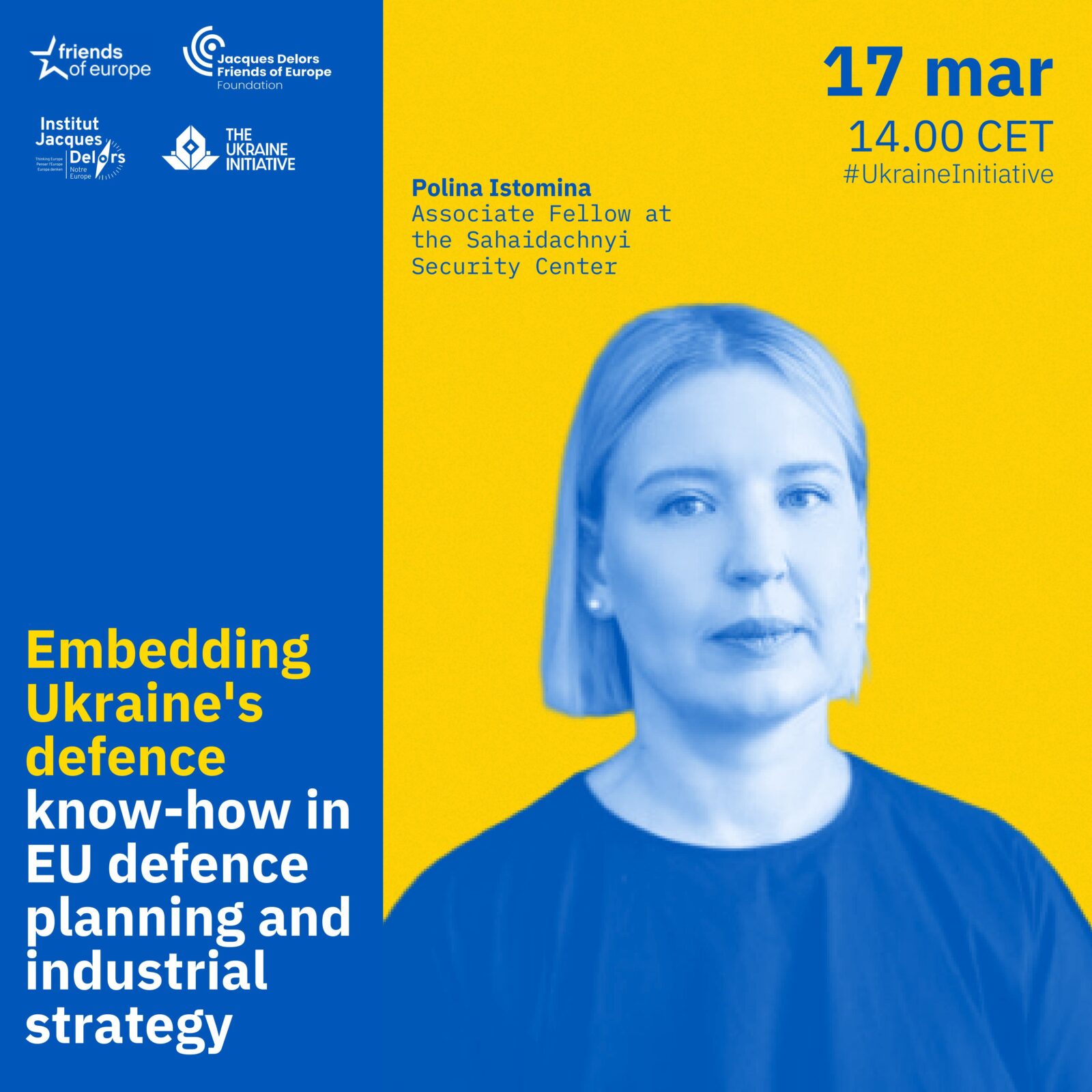
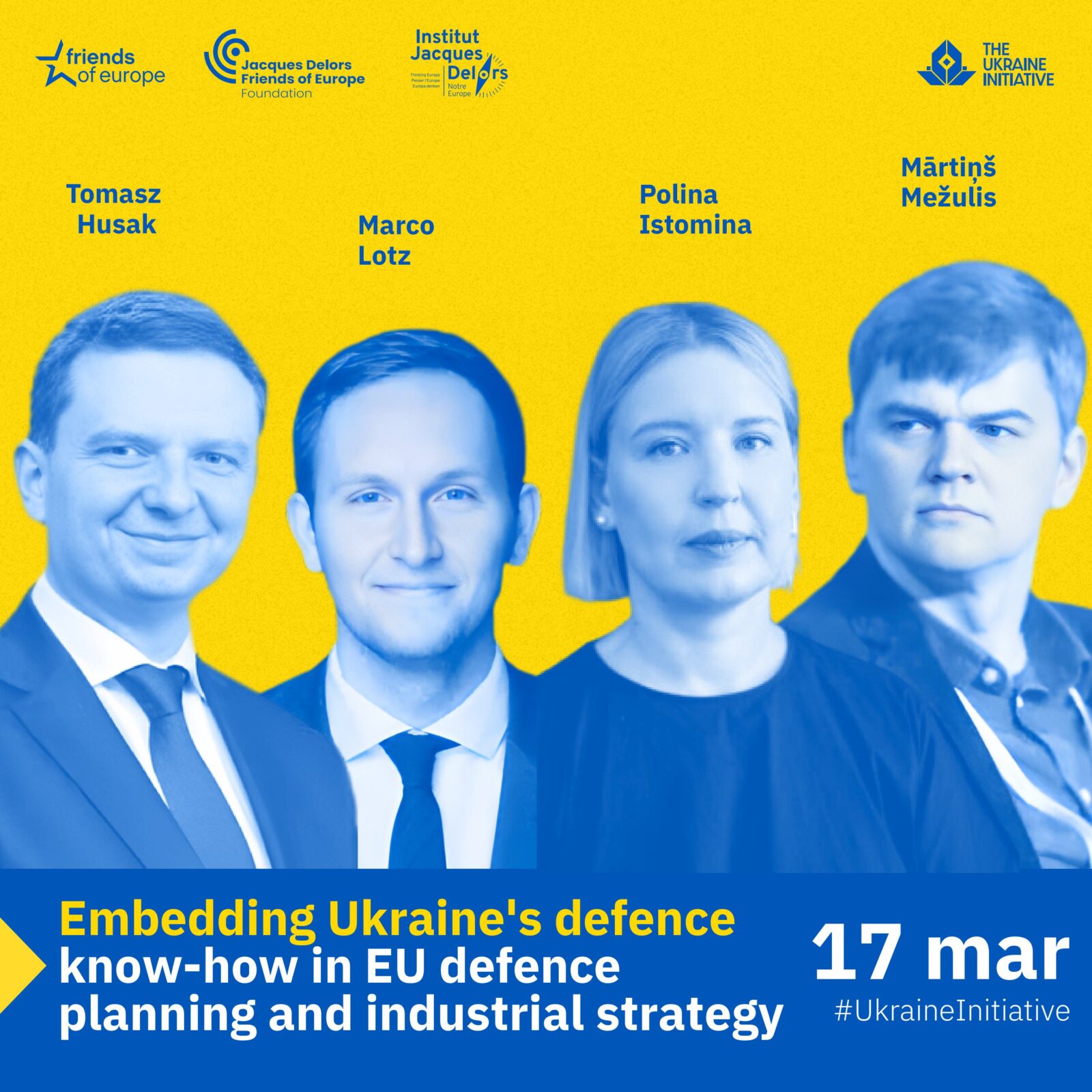
On March 17, Friends of Europe and the Jacques Delors Institute hosted a debate on how Ukraine’s wartime experience should be reshaping EU defence planning, procurement, and industrial policy.
Polina Istomina, Sahaidachnyi Security Center’s Associate Fellow and UK-Ukraine Programs Specialist, joined the panel alongside
- Tomasz Husak (Director of Defence Policy, European Commission Directorate-General for Defence Industry and Space),
- Marco Lotz (Business Development and Governmental Relations Manager at Quantum Systems and Chair of the Ukraine Working Group at the Aerospace, Security and Defence Industries Association of Europe),
- Martins Mezulis (Adviser to the Secretary of State for Defence Industry and Innovation at the Ministry of Defence of Latvia).
Ukraine’s defence ecosystem and Europe’s procurement frameworks operate on fundamentally different logics, and the debate was largely about what it would take to make them work together. The question is no longer whether Europe should learn from Ukraine, but whether it can do so fast enough to make a difference.
Istomina drew attention to practice:
- Ukraine’s hybrid model compresses delivery to days,
- routes decisions through battlefield data,
- and uses civil society as an accountability mechanism.
“It is critically important not to lose sight of the end user and to adopt new approaches to drone procurement — based on battlefield data,” emphasizes Polina Istomina.
That urgency ran through the broader discussion as well. The panel covered the structural side of that gap – fragmented EU acquisition frameworks, the pace of innovation cycles, and what it would take for European industrial systems to move at a tempo that frontline realities actually demand. This extended to the longer-term architecture:
- rebalancing investment between legacy platforms and emerging defence technology firms,
- adjusting regulatory frameworks to bring private capital into defence innovation, and
- structuring EU-Ukraine industrial cooperation through joint ventures and integrated supply chains.
The debate highlighted that translating Ukraine’s operational knowledge into EU defence structures will require more than political commitment — flexible procurement frameworks, industrial integration, and a permanent channel to frontline realities are crucial to have sizable impact in practice.